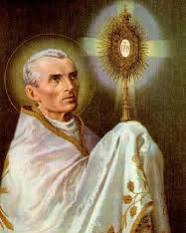
The Lives of the Saints: August 3
Saint Peter Julian Eymard (1811–1868) — Apostle of the Eucharist
Saint Peter Julian Eymard was a 19th-century French priest whose life was defined by an all-consuming devotion to the Real Presence of Jesus Christ in the Holy Eucharist. He overcame immense personal hardships and institutional obstacles to spark a global Eucharistic revival.
       [ Early Life ] -> Worked in father's shop / Secretly studied Latin
              |
      [ Ordination (1834) ] -> Diocesan Priest in Grenoble
              |
      [ Marist Order (1839) ] -> Traveled Europe preaching missions
              |
 [ Eucharistic Vision (1845) ] -> Called to center life on the Blessed Sacrament
              |
   [ Foundations (1856-1858) ] -> Established Men's & Women's Congregations
Early Obstacles and the Call to Priesthood
Born into a poor family of craftsmen in La Mure, France, Peter Julian felt a profound pull toward the altar from early childhood. An early account notes that at just five years old, he was found in his village church with his ear pressed against the tabernacle door, explaining that he “could hear Jesus better that way”.
Despite his clear vocation, his father intensely opposed his path and forced him to work as a cutler in the family workshop. Undeterred, Peter Julian secretly studied Latin grammar during his rare breaks. Following his father’s death, he finally entered the seminary in Grenoble and was ordained a diocesan priest in 1834 at the age of 23.
From Parish Priest to Founder
Seeking a more intense community life, Father Eymard joined the Marist Fathers (Society of Mary) in 1839. He proved to be an exceptional spiritual director and an energetic preacher, traveling across Europe to lead parish retreats. However, two major spiritual breakthroughs altered his path forever:
- The Corpus Christi Procession (1845): While carrying the Blessed Sacrament, he felt a powerful, mystical urge to preach nothing but Christ in the Eucharist.
- The Shrine of Fourvière (1851): He was hit with a clear inner certainty that a religious order dedicated exclusively to perpetual adoration needed to be established.
Recognizing that this was his true calling, he took the painful step of leaving the Marists. In 1856, he and Father Raymond De Cuers co-founded the Congregation of the Blessed Sacrament for men in Paris. Two years later, alongside Mother Marguerite Guillot, he founded the Servants of the Blessed Sacrament for women.
A Legacy of Adoration and Service
Father Eymard firmly believed that Eucharistic adoration was not a passive retreat from the world, but the ultimate fuel for charity. His communities guarded the Blessed Sacrament around the clock while concurrently running massive outreach programs. They fed the poor in the slums of Paris, visited prisons, and educated young, neglected workers to prepare them for their First Holy Communion.
Though plagued by severe respiratory illness, financial ruin, and painful spiritual dryness in his later years, he spent his remaining energy writing books on the Eucharist. He died in his hometown at age 57. Pope John XXIII canonized him in 1962, officially declaring him the “Apostle of the Eucharist”.
Saint Lydia of Thyatira (1st Century) — First European Convert
Saint Lydia of Thyatira (sometimes called Saint Lydia of Philippi) is a monumental figure in the New Testament. Recorded in Chapter 16 of the Acts of the Apostles, her conversion marks the exact historical turning point where Christianity crossed from Asia into Europe.
  [ Business in Thyatira ] -> High-end industry of extracting purple dye
              |
 [ Move to Philippi (Greece) ] -> Strategic business expansion to a Roman colony
              |
   [ Riverbank Prayer Site ] -> Met Saint Paul due to lack of a city synagogue
              |
   [ Heart Opened & Baptized ] -> First documented European Christian convert
              |
    [ The First House Church ] -> Turned her estate into a missionary safe haven
An Independent Woman of Commerce
Lydia was born in Thyatira, a city in Asia Minor (modern-day Turkey) renowned for its advanced textile and dye industries. She operated as a high-end merchant dealing in Tyrian purple cloth. In antiquity, purple dye was an extraordinary luxury extracted from thousands of marine mollusks or specialized madder root. Because purple clothing was reserved exclusively for royalty, nobles, and elites, Lydia’s trade required immense capital.
She successfully expanded her business across the Aegean Sea to Philippi, a prosperous Roman military colony in Macedonia (Greece). Historians note that she lived as an independent woman and the clear head of her own wealthy household—a highly unique and powerful status for a woman in the Roman Empire.
The Encounter by the River
Though she was a Gentile by birth, Lydia rejected Roman paganism and became a “worshiper of God,” a term used for Gentiles who embraced Jewish monotheism. Because Philippi had a very small Jewish population, the city lacked a formal synagogue. On the Sabbath, Lydia and a group of local women gathered outside the city gates at a nearby riverbank to pray.
Around 50 AD, the Apostle Paul, accompanied by Silas, Timothy, and Luke, arrived in Philippi after Paul received a vision calling him to Macedonia. Paul sought out the river prayer site and began to preach the Gospel of Jesus Christ. As Scripture notes, “The Lord opened her heart to respond to Paul’s message”.
The Bedrock of the European Church
Lydia immediately accepted the Gospel and was baptized alongside her entire household. She then used her considerable resources to secure the safety of the apostles, insisting, “If you consider me a believer in the Lord, come and stay at my house”.
Her spacious home instantly became the very first “house church” on European soil. It provided a vital sanctuary, financial backing, and a central meeting point for the rapidly growing Christian community of Philippi. Through her leadership, hospitality, and commercial influence, Lydia laid the groundwork for the spread of Western Christianity.